 ThreeMatchBan
The back page of a British tabloid is a strange and wonderful thing. It has perhaps a dozen words to sell a story, a photograph the size of a dinner plate and a readership that will forgive almost anything except boredom. The result, for decades, has been the football pun: sometimes brilliant, often terrible, occasionally both at once.
These week-in-review pieces look back at the headlines of the 2010–11 season, one week at a time, with the benefit of knowing how each story turned out. The puns are kept where they are clean and still funny. The crude ones are left on the newsprint where they belong.
The art of the back-page pun
Every football fan has a favourite. The most famous of all came from Scotland in February 2000, when Inverness Caledonian Thistle won 3–1 at Celtic Park in the Scottish Cup and The Sun produced "Super Caley Go Ballistic, Celtic Are Atrocious". It worked because it was ridiculous, because it scanned, and because it was true. Celtic's manager, John Barnes, was gone within days.
England managers have suffered most. After England lost to Sweden at Euro 92, Graham Taylor became a turnip on the front of The Sun, and the vegetable followed him for the rest of his career. Fabio Capello, Steve McClaren and others all had their own versions. A manager's name that rhymes with something is a gift, and a name that can be made to sound like a food, a film or a song is a jackpot.
There are rules, unwritten but strict. A pun must be readable at a glance from across a newsagent's. It should use a phrase the reader already knows: a song title, a catchphrase, an advert, a film. Rhymes earn bonus points. Sense is optional. And the broadsheets, which pretend to be above all this, cannot resist joining in when the story is big enough, as the Independent and the i proved during the Giggs injunction saga.
Why 2010–11 was a vintage season
Few seasons have given the red-tops more to work with. It began with England still reeling from the World Cup in South Africa and Fabio Capello under siege. Liverpool were sold after a High Court battle, sat in the relegation zone in October and changed manager in January. Wayne Rooney announced he wanted to leave Manchester United, flirted with City and signed a new contract within days.
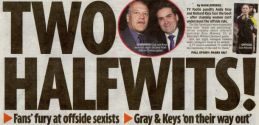
January brought Richard Keys and Andy Gray's off-air comments about the assistant referee Sian Massey, and the end of their Sky Sports careers. Deadline day brought Fernando Torres to Chelsea for a British record £50 million and Andy Carroll to Liverpool for £35 million. February brought Tottenham's win at San Siro and Arsenal's victory over Barcelona. May brought United's record 19th league title, Manchester City's first FA Cup since 1969, and the collapse of Ryan Giggs's privacy injunction, which put a footballer on the front of almost every paper in the country on the same morning.
In the middle of it all were the sub-editors, working to deadline, trying to fit a striker's surname into a song lyric before the presses rolled. Some of their work was inspired. Some was tasteless. Most of it was simply daft, which is the point. The way the papers turned on England during that era is covered separately in England stumble and the press pounce, and the strange relationship between footballers and the gossip columns in how the tabloids treated Rooney and Beckham.
Reading them now
The joy of looking back is hindsight. Headlines that declared John Terry finished were written two years before he lifted the Champions League trophy in Munich. A Cobblers pun about Liverpool's League Cup exit landed on a manager who would be gone within four months. "Blue Roon" was written about a player who went on to become Manchester United's record scorer. Each week is presented as it was, with the ending added where it is certain.
The papers themselves have changed. Print sales have fallen sharply since 2010, the back page now competes with phone notifications, and many of the best puns live on social media for an afternoon before vanishing. The 2010–11 season sits near the end of the era when the back page still set the agenda for the day's football conversation.
More week in headlines
Every week from the collection, roughly in the order the season unfolded:
- Fabregas, Beckham and Terry: Barcelona chase Arsenal's captain, Capello calls Beckham too old and Terry is written off far too soon.
- Balotelli and the Liverpool takeover: Manchester City close in on Mario Balotelli while Liverpool hunt for anyone able to buy the club.
- Woe Cole and Maradona at Villa: Joe Cole is sent off on his Liverpool debut and Diego Maradona is linked with the Villa Park vacancy.
- Liverpool and the Cobblers: Northampton Town win at Anfield, Arsenal's title credentials are doubted and Emile Heskey answers his critics.
- England and the fool Monte: a goalless draw with Montenegro at Wembley and a Rooney remark that started a week of chaos.
- Red flops and a blue Roon: Liverpool sink into the bottom three and Rooney says he wants to leave Old Trafford.
- Chicharito and Wenger's ski lift: Javier Hernández wins over United fans and his nickname becomes a pun factory.
- Torres reborn and Carew's exit: Torres sinks Chelsea, Hargreaves lasts five minutes and the Manchester derby falls flat.
- Woe-vember at Chelsea: the champions lose their assistant manager and their form, while Nani and Rooney get puns of their own.
- Deadline day 2011: Carroll to Liverpool, Torres to Chelsea, Dzeko's rescue at Notts County and the fallout from the Sky Sports row.
- North London's European week: Spurs win at San Siro, Arsenal beat Barcelona and Torres still cannot score.
- United's 19th title: the title is taken as red, Peter Crouch scores at the wrong end and Fifa insists it is clean.
- The Ryan Giggs special: the week a privacy injunction met Twitter and Parliament and lost.
- Walcott, Hansen and Lampard: a tea advert, a cartoon sailor and a chocolate bar raided for football puns.
Graham Taylor, for what it is worth, took the turnip with remarkable good grace in later years. Not every target of the back page was so forgiving.