 ThreeMatchBan
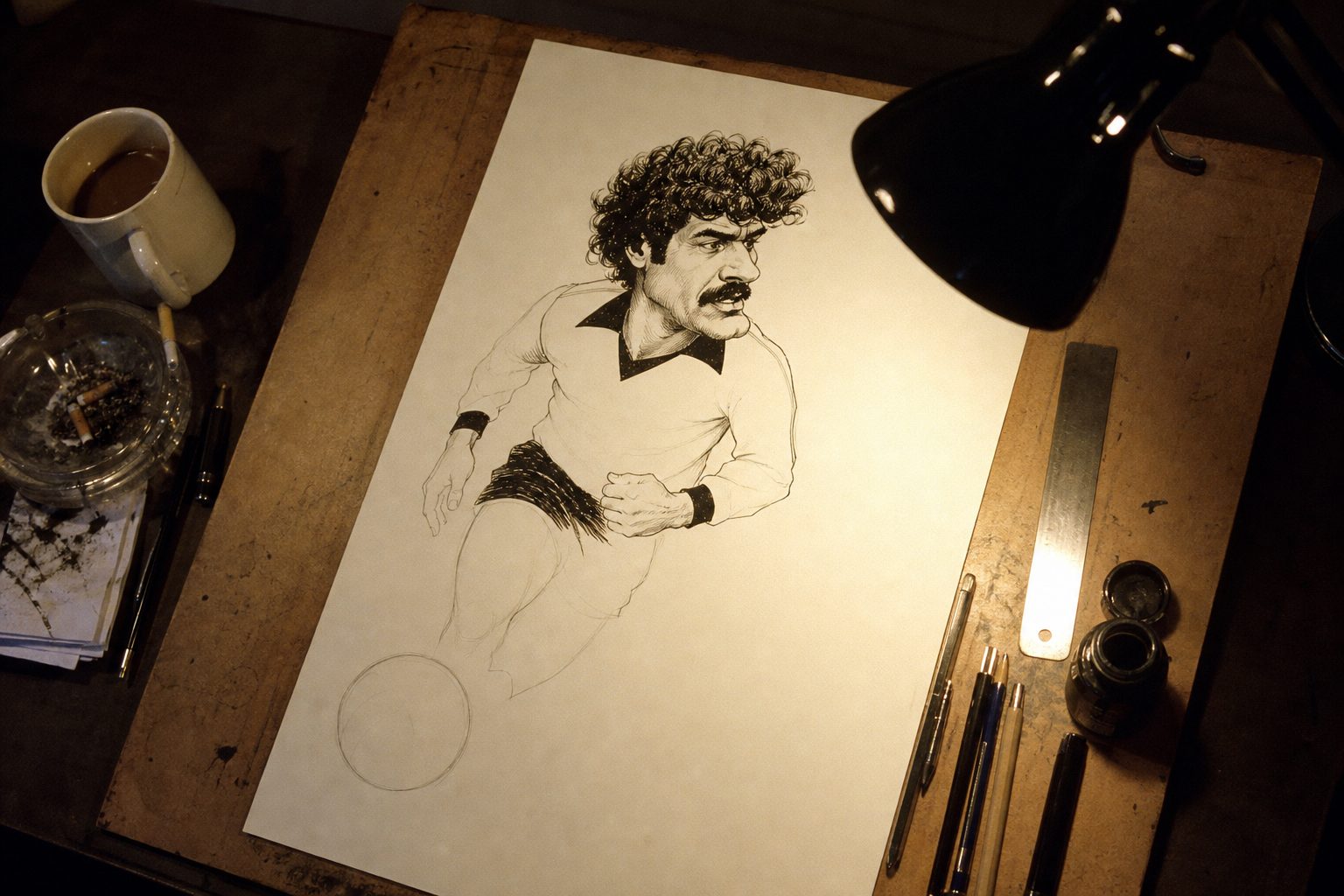
There is a particular kind of football portrait that only works if the artist loves the subject a little too much. Davey Blackett's set of five cartoon cards falls squarely into that category: thick black outlines, a grey halftone background that recalls a cheap 1980s sticker print, a name in big hollow capitals across the top, and a face reduced to a handful of strokes that somehow still captures the whole player.
The choice of subjects says plenty about the taste behind it. No Messi, no Ronaldo. Instead there is a Dutch libero, a Danish playmaker, a Colombian with a hairstyle visible from orbit, a Basque centre-forward and the slowest genius Argentina ever produced. Each one gets a kit drawn with real care, down to the collar trim and the maker's mark on the chest.
Ronald Koeman and the Wembley free kick
Koeman comes first, blond hair spiking upwards and a jaw that looks as though it has never once been talked out of anything. The orange shirt with its white piping and lion on the chest is the late-1980s Netherlands look, the era in which he won the European Championship in 1988 alongside Ruud Gullit, Marco van Basten and Frank Rijkaard.
That same year he won the European Cup with PSV Eindhoven. Four years later he struck the free kick that beat Sampdoria 1–0 at Wembley in extra time and handed Barcelona their first European Cup. For a defender, his goal tally was absurd, built on penalties and dead balls hit with frightening power.
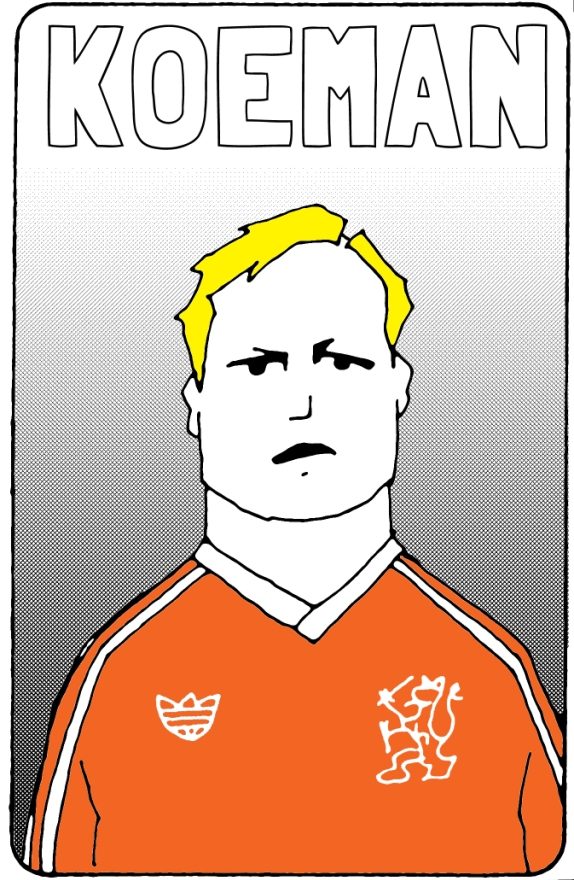
The expression in the drawing fits the man who later became a manager of some stubbornness, taking charge of Southampton, Everton, Barcelona and the Netherlands national side. The cartoon catches him before all of that, a footballer whose face seemed permanently set to "unimpressed".
Michael Laudrup, the reluctant star
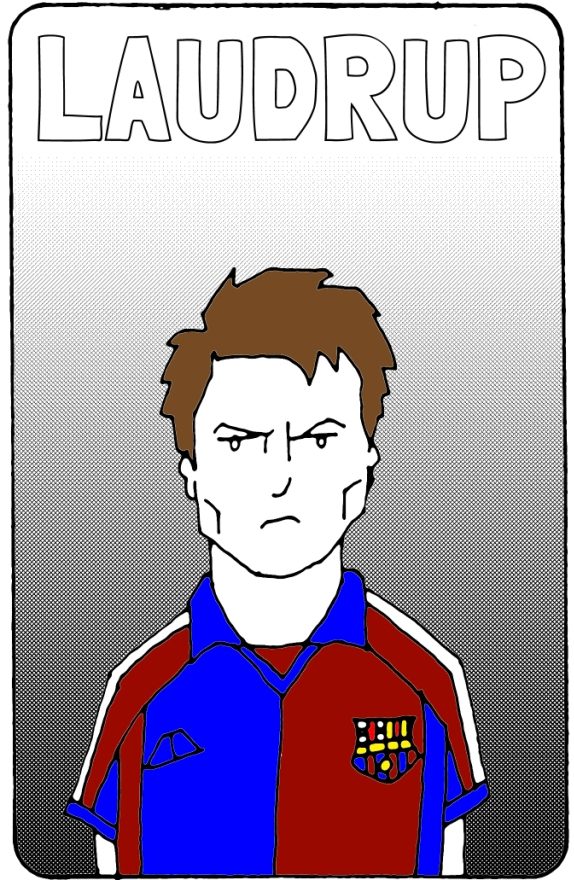
Laudrup is drawn frowning in the blue and claret halves of Barcelona, the Kappa logo on the chest of the shirt he wore in Johan Cruyff's Dream Team. He won four successive league titles there before doing the unthinkable and joining Real Madrid in 1994, where he promptly won another. His passing was so disguised that team-mates sometimes needed a second to realise the ball was coming to them.
By the autumn of 2011 he was a coach, fresh from a spell at Mallorca, and the portrait was a reminder that the calm figure on the touchline had once been the most elegant player in Spain. A year later he arrived at Swansea City, and in February 2013 his side beat Bradford City 5–0 at Wembley to win the League Cup, the first major trophy in the Welsh club's history.
Carlos Valderrama: hair first, football second
Every cartoonist dreams of a subject like Valderrama. The drawing gives him a vast cloud of pale yellow hair, a thick moustache and the yellow Colombia shirt with the number 10 in blue, the Umbro diamond on the chest. It is exactly how a generation of viewers remember him from the World Cups of 1990, 1994 and 1998.
The image could easily have been a joke, but the man underneath the perm was a playmaker of rare patience. He barely ran, rarely lost the ball and seemed to pass in slow motion while everybody else hurried. Spells at Montpellier and Real Valladolid in Europe were followed by years in Major League Soccer, where he became one of the early faces of the American league with the Tampa Bay Mutiny.
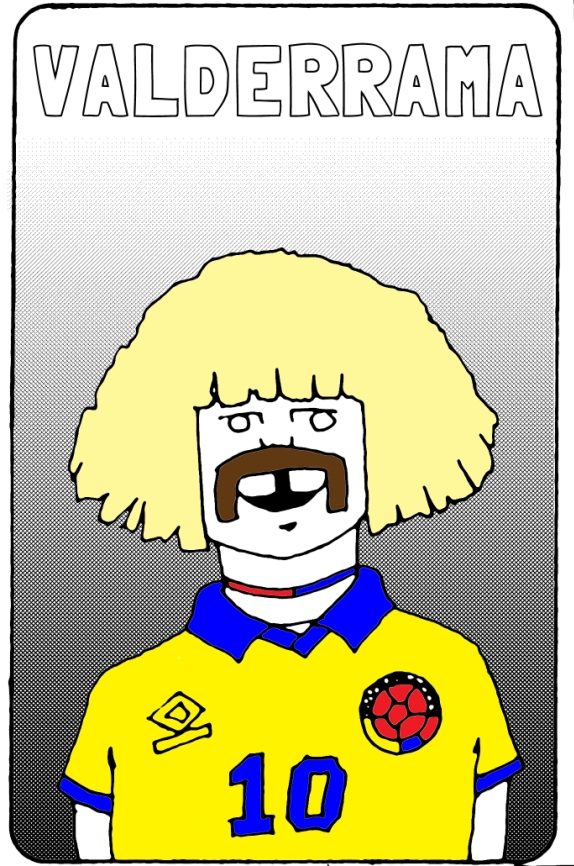
Of the five portraits, this is the one that needs no name across the top. Anyone who owned a 1990s sticker album would know him from the hair alone.
Fernando Llorente and the red and white stripes
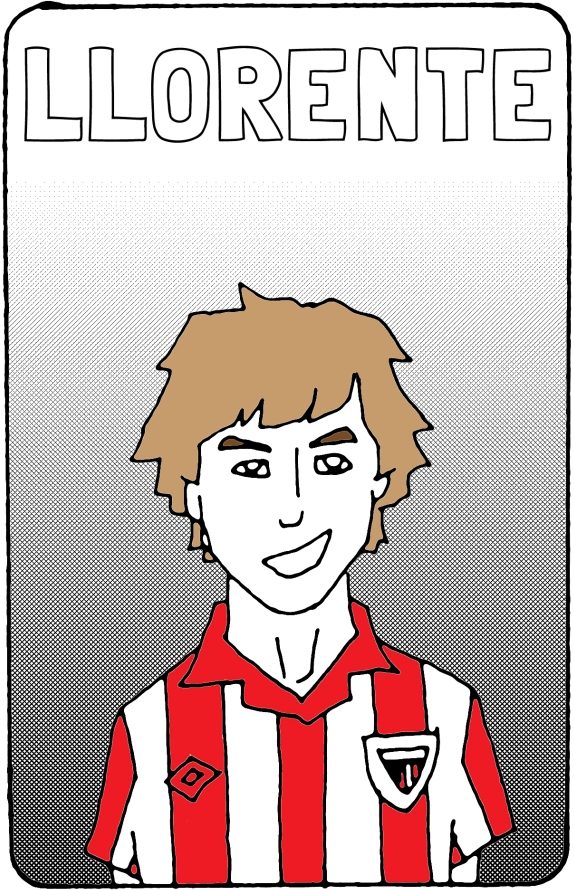
Llorente is the cheerful one, grinning out of the red and white stripes of Athletic Club, the Bilbao side that famously only fields players with Basque roots. In 2011 he was the focal point of Marcelo Bielsa's thrilling, exhausting team, which went on to reach the Europa League final the following May before losing 3–0 to Atlético Madrid in Bucharest.
He was already a world champion, a squad member when Spain won the 2010 World Cup in South Africa, and he was in the party that retained the European Championship in 2012. His later career took him to Juventus, Sevilla, Swansea, Tottenham and Napoli. Spurs supporters will always remember the goal off his hip against Manchester City that carried them into the 2019 Champions League semi-finals.
Román, the slowest genius
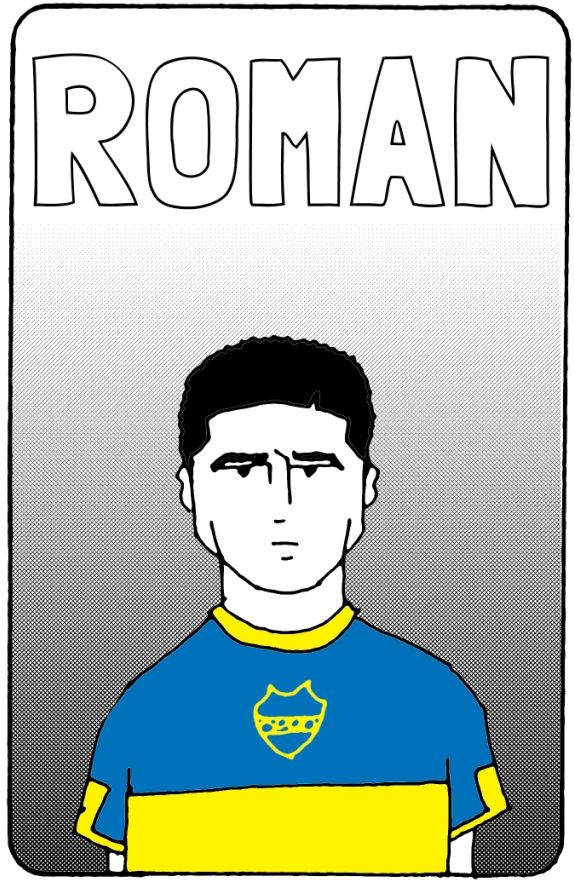
The final card does not bother with a surname. It simply reads ROMAN, and in Argentina that is enough. Juan Román Riquelme is drawn with heavy-lidded eyes and the hunched look of a man who never appeared to be in a hurry, wearing the blue shirt with the yellow band of Boca Juniors.
At Boca he won the Copa Libertadores three times, in 2000, 2001 and 2007, and his performance in the 2007 final against Grêmio is still talked about in Buenos Aires as one of the great individual displays in the competition's history. Europe never quite worked out what to do with him at Barcelona, though at Villarreal he steered a small-town club to the 2006 Champions League semi-finals, where his late penalty was saved by Jens Lehmann and Arsenal went through.
He remained a Boca figure long after his playing days ended, rising through the club's board to become its president in December 2023. The cartoon, all droopy eyes and quiet menace, captures the paradox perfectly: a footballer who looked half asleep and saw everything.
Where to find more
The set was only a sample. More of Blackett's pen strokes, comics and general points of amusement could be found on the Davey Mail, and he was also posting new sketches on Twitter. Readers who fancy testing their own recall of faces from the album era can try to name the world football stars from their stickers, or move on to the Copa América sticker quiz, where at least one curly-haired Colombian may look familiar.
For more Argentine playmakers in the Riquelme mould, the story of the many "new Maradonas" covers the burden that every gifted number 10 from Buenos Aires has had to carry. Valderrama, for the record, never needed comparing with anyone.