 ThreeMatchBan

- 1972Official club crest with a ship, red and white stripes and a football.
- 1997Current crest introduced in July with the move from Roker Park to the Stadium of Light, with the motto Consectatio Excellentiae.
- 2018October: the club tells a supporters' group the badge and motto are under review for a simpler design.
- 2018November: chairman Stewart Donald rules out a change and the crest is kept.
- 2020The motto Consectatio Excellentiae is registered as a trademark.
The Sunderland crest is a map of Wearside folded into a shield. Penshaw Monument stands in one corner, the Wearmouth Bridge in another, a colliery wheel joins them, two lions flank the shield and a Latin motto runs underneath. It was drawn for a fresh start, the move from Roker Park to the Stadium of Light in July 1997, and in a little under thirty years it has survived one serious attempt to simplify it.
Most club crests carry one or two local symbols. The Sunderland badge carries five, which is why it rewards being read piece by piece.
A crest made for the Stadium of Light
Sunderland were founded in 1879 and played at Roker Park from 1898 until 1997, almost a century on one ground. Leaving it was a big moment for the club and the city, and the new crest was introduced alongside the move, the same pairing that West Ham would repeat at the London Stadium in 2016. The West Ham badge lost a castle in the process; Sunderland's gained a skyline.
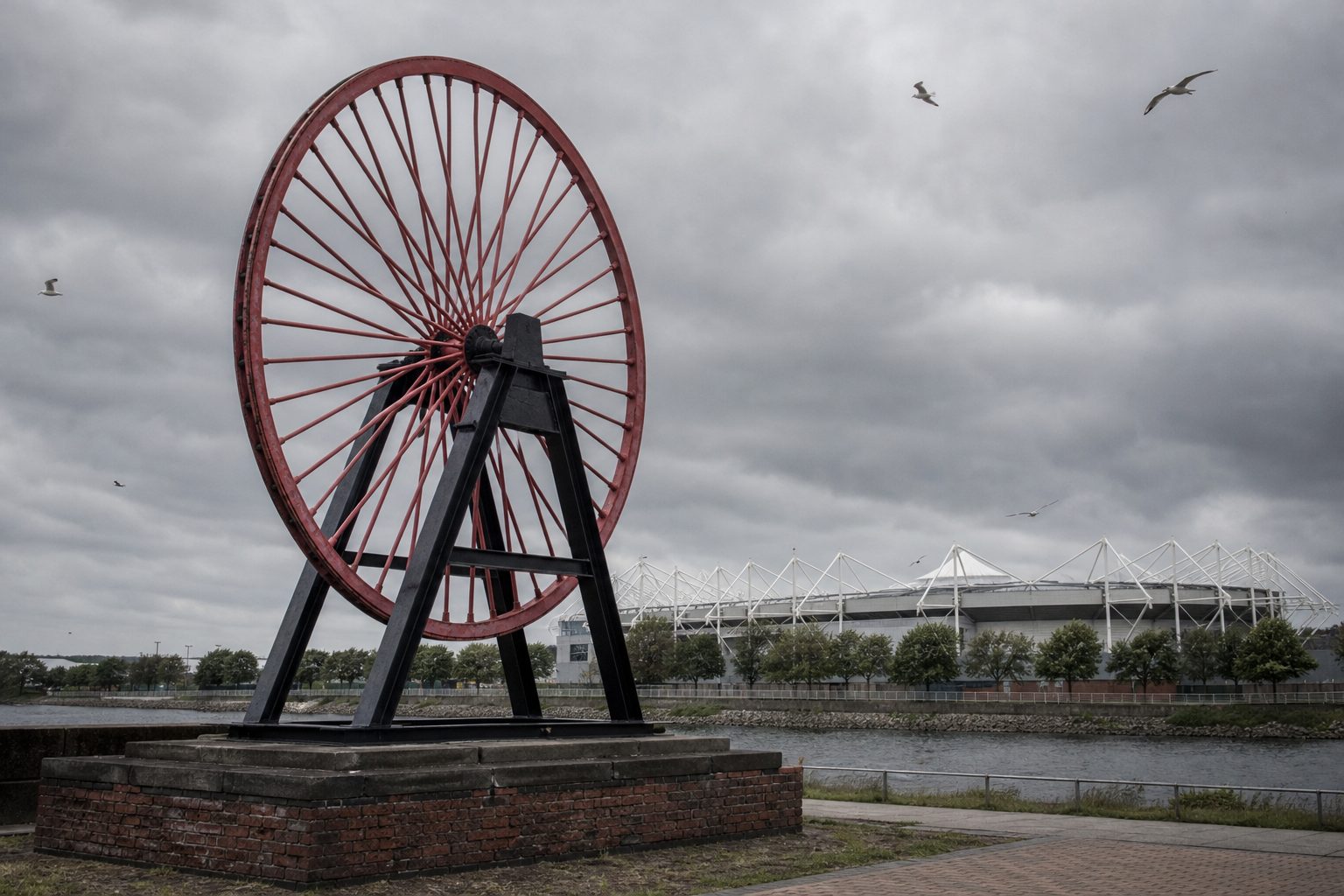
The location of the new ground shaped the badge directly. The Stadium of Light was built on the site of the former Wearmouth Colliery, and the colliery wheel on the crest recalls the County Durham coalfield on which so much of the area was built. Few crests in England are so literally tied to the ground beneath the stadium.
The four quarters of the Sunderland crest
The shield is split into quarters, and each has a job.
- Penshaw Monument, top left: the Greek-temple folly on a hill outside the city, a nod to the support the club draws from beyond Sunderland itself.
- The Wearmouth Bridge, bottom right: the crossing that links the north and south sides of the city over the River Wear.
- Red and white stripes, in the remaining quarters: the shirt, in its simplest form.
The colliery wheel completes the set of symbols. The colours across the whole design are red, white, black and gold, the same palette as the shirt with a little extra shine.
Two lions and a Latin motto
The lions supporting the shield come from the arms of the City of Sunderland, which gives the crest a civic backbone to go with its landmarks. Underneath runs a red and gold banner carrying "Consectatio Excellentiae", Latin for "in pursuit of excellence". The motto arrived with the 1997 crest; it had no place on the earlier badge.
Latin mottoes have become rarer on English crests, which makes Sunderland's a minor curiosity. Everton fought to keep theirs in 2013 and won. Sunderland's own came close to disappearing in 2018, and the club registered it as a trademark in 2020.
The old Sunderland badge: a ship on the Wear
Before 1997, the badge was a much simpler affair. From 1972 the official club crest showed a ship, with red and white stripes and a football. A year later came the club's most famous afternoon, the 1973 FA Cup final, when Bob Stokoe's Second Division side beat Leeds United 1–0 at Wembley in one of the great upsets.
The ship tells the town's other industrial story. Shipbuilding on the Wear was once as central to Sunderland as coal, and between them the old Sunderland badge and the new one cover both trades.
Across the region, the Newcastle United badge leans on the same kind of local heraldry, with castle and seahorses from the city arms, and in 2026 it was redrawn after a supporter vote.
2018: the review that never happened
In October 2018, Charlie Methven, then part of the new ownership group, told a supporters' group that the badge and the motto were being reviewed with a simpler design in mind. The reaction was swift. Within days chairman Stewart Donald ruled the change out, saying the crest belonged to the fans, and it was kept.
It is a short episode in Sunderland badge history but a telling one. Busy crests have fallen out of fashion, and a designer would struggle to fit five symbols onto a phone-app icon. Supporters were not interested in that argument. The crest stays as drawn in 1997, and the full list of club histories is on the football badges hub, with the wider story in the evolution of Premier League club badges from Newcastle United to Wolverhampton Wanderers. On Boxing Day 2015, Sunderland were also the opponents when City first showed off their new roundel, as the Man City badge history recalls.