 ThreeMatchBan
- Mid-1930sThe club uses the arms of Bournemouth and Boscombe.
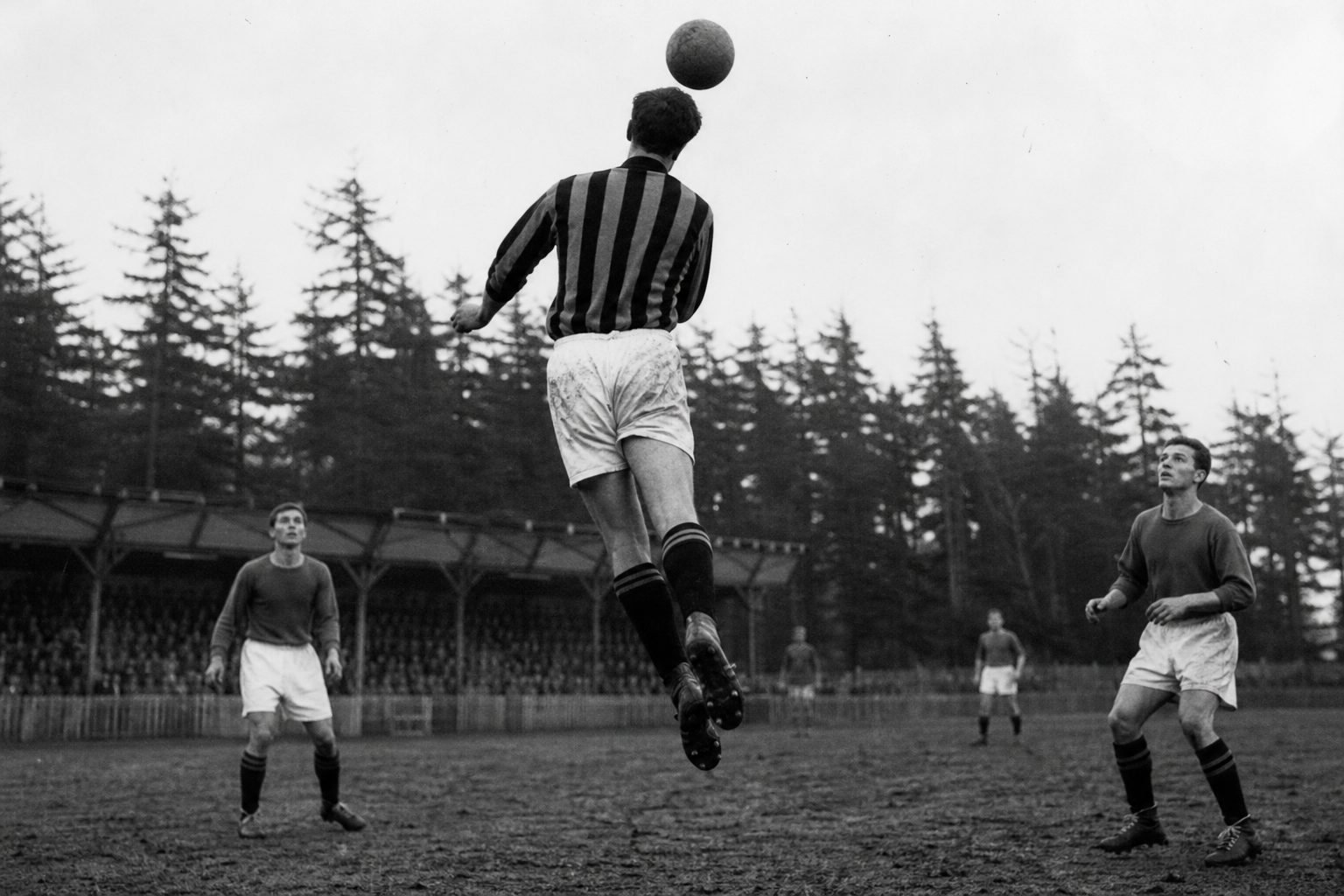
- Early 1970sThe club becomes AFC Bournemouth and adopts a crest with a silhouette of Dickie Dowsett heading a ball.
- 1981A cherries badge, based on the nickname, replaces the heading player.
- 1983The heading player returns.
- 2013/14A revised crest with the name in gold drops the red and white striped motif; it first appears on the 2014/15 shirt.
Most club badges are built from animals, buildings or civic heraldry. The Bournemouth badge is built from a person. At its centre is the silhouette of a footballer heading a ball, and that footballer was real: Dickie Dowsett, whose outline has represented the club for most of the last half-century. It is a lovely idea, and one that very few clubs have copied.
From Bournemouth and Boscombe to AFC Bournemouth
The club spent most of its history as Bournemouth and Boscombe Athletic, and its first emblem reflected that. From the mid-1930s it used the arms of Bournemouth and Boscombe, a borrowed civic design of the kind most English clubs wore at the time.
The break came at the start of the 1970s, when the club renamed itself AFC Bournemouth. Sources disagree on whether the change belongs to 1971 or 1972, but they agree on what came with it: a new crest, and a new idea. Instead of shields and towers, the club chose a player in action, the silhouette of Dickie Dowsett rising to head a football.
Dowsett had been a forward for the club, and his inclusion turned the crest into something personal. When he died, the club paid tribute to him as the man on the badge. Not many former players can claim to be worn on every shirt the club sells.
The choice says something about the era. The early 1970s were the years when English clubs began to treat the badge as their own property rather than a borrowed piece of local government. Nottingham Forest held a newspaper competition in 1973 because they could not copyright the city's arms, and others reached similar conclusions. Bournemouth went further than most by leaving heraldry behind altogether. A silhouette of a local player belonged to nobody but the club.
The 1981 cherries detour
In 1981 the heading player was dropped in favour of a cherries badge, a literal take on the club's nickname. It did not last. By 1983 the silhouette was back, and the cherries became a curiosity for collectors and retro shirt enthusiasts.
Where the nickname comes from is itself disputed. Historical Football Kits records two theories: one connects it to the Dean Court era, the other to the cherry-red striped shirts the club wore. Either way, "the Cherries" stuck, even if the fruit only made it on to the badge for a couple of seasons.
That two-year detour makes the 1981 version one of the more interesting old Bournemouth badges to find on a programme or a pin. It is easy to date precisely because it was so short-lived.
The 2013 update and the gold lettering
The modern Bournemouth crest arrived in 2013/14 and was first worn on the 2014/15 shirt. It kept the heading player but tidied up everything around him. The club name was set in gold, and the red and white striped motif that had sat behind the design was dropped.
The timing turned out well. In 2015 Eddie Howe's side won the Championship and reached the top flight for the first time, so the gold-lettered crest was the one that made its Premier League debut. A small club on the south coast arrived among the giants with a badge that showed a man heading a ball, which felt about right.
For anyone sorting through old Bournemouth badges, the changes make dating straightforward. A civic shield means the Bournemouth and Boscombe years. A heading player against red and white stripes points to the years before the 2013 update. Gold lettering and no stripes means the current crest, worn from 2014/15 onwards.
Bournemouth crest elements
- The silhouette: Dickie Dowsett heading a football.
- The cherries: the nickname, on the badge from 1981 to 1983.
- Colours: red and black, with gold lettering since 2013.
- Motto: none.
Bournemouth's history sits alongside its neighbours in the evolution of Premier League badges from Arsenal to Manchester United. For contrast, Fulham's 2001 shield abandoned civic arms for a monogram, Everton's tower crest survived a fan revolt in 2013 and Chelsea's lion has been redrawn several times since the 1950s. Every club history is collected in the football badges section.
Plenty of badges honour a place. The Bournemouth badge honours a header.