 ThreeMatchBan
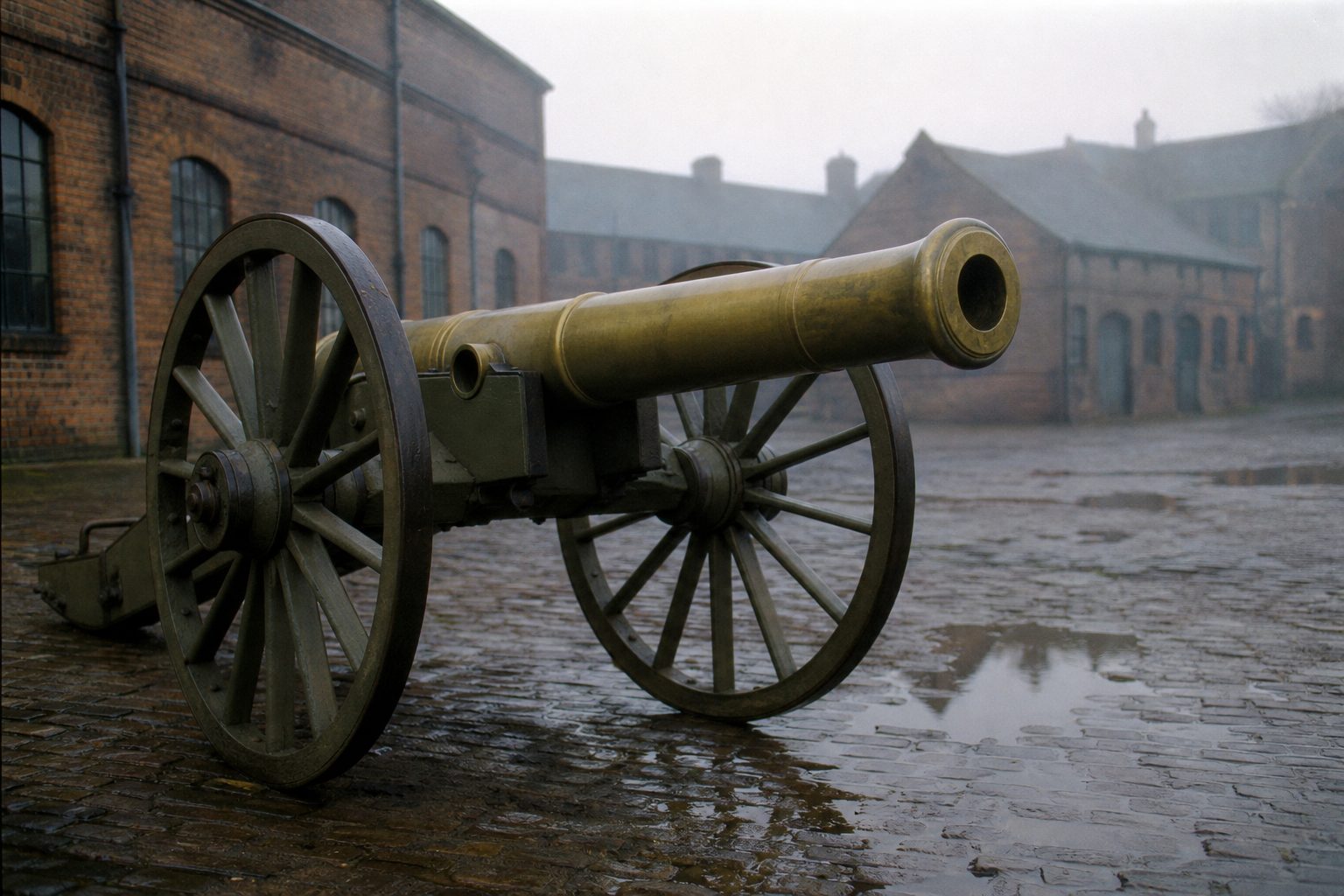
- 1922/23An eastward-pointing cannon appears in the first matchday programme of the season, against Burnley, and is used for three seasons.
- 1925/26The cannon turns back to face west and is joined by the words The Gunners.
- 1949/50The Victoria Concordia Crescit crest arrives: gothic Arsenal lettering, a westward cannon, the Islington arms and ermine.
- 1990The 1949 crest is worn on the pitch for the first time.
- 2001/02The old crest is cleaned up: solid yellow replaces the gold tones and the motto gets a plainer typeface.
- 2002A new crest is introduced to embrace the future, in traditional colours plus metallic gold.
- 2011/12A one-off 125th anniversary crest with 15 oak and 15 laurel leaves, the first motto Forward and the dates 1886–2011.
Few emblems in English football carry their origin story as openly as the Arsenal badge. The cannon points straight back to the club's beginnings among workers at the Royal Arsenal in Woolwich in 1886, and every Arsenal crest since the early 1920s has kept a gun at its heart. What has changed, again and again, is the direction the barrel faces, the lettering wrapped around it and the reasons the club gave for touching it at all.
The short version runs like this: a simple cannon in the 1920s, an ornate heraldic crest from 1949, a tidy-up at the turn of the millennium and a clean modern badge from 2002 that is still on the shirt. The longer version is more interesting.
The Arsenal crest today: the 2002 badge
The badge on the current shirt dates from 2002. The club presented it as a crest designed "to embrace the future", and the timing explains the phrase. The move from Highbury to a new stadium at Ashburton Grove, later the Emirates, was coming, and Arsenal wanted an identity built for the next era rather than one inherited from the 1940s.
There was a commercial reason too. Historical Football Kits records that the old crest could not be registered for copyright, which left the club unable to fully protect the most valuable image it owned. Arsenal were hardly alone in that bind: Chelsea's 1986 redesign was driven by exactly the same problem, and so was Nottingham Forest's tree in the 1970s.
The 2002 design kept the traditional colours and added metallic gold. It is compact, legible at the size of a phone screen and easy to stitch, which is precisely what a modern Arsenal emblem has to be. Plenty of supporters still prefer the old one. Few would argue the new Arsenal emblem fails at its job.
Old Arsenal badges, from the 1920s programme to 1949
The first cannon turned up in the 1922/23 season, printed in the matchday programme for the opening game against Burnley. That early gun pointed east, and it lasted three seasons. In 1925/26 the club swung it round to face west and added the words "The Gunners", a nickname that by then belonged to the club as much as the gun did.
Then came the crest most people mean when they talk about the old Arsenal crest. Introduced for 1949/50, it carried the motto "Victoria Concordia Crescit", a gothic "Arsenal" across the top, the westward cannon, the arms of the Borough of Islington and a band of ermine. The motto translates as "Victory grows out of harmony" and came from Harry Homer, who wrote in the programme under the name "Marksman" during the 1947/48 season.
That design stayed largely unchanged for 53 years. Strangely, for most of that time it lived on letterheads, programmes and the stadium rather than the players' chests: Historical Football Kits dates its first appearance on the pitch to 1990. So an entire generation grew up with the old Arsenal crest on their bedroom walls, a badge the team had rarely worn.
The 2001/02 clean-up
Before the clean break came a quieter change. For 2001/02 the 1949 crest was "cleaned up" for commercial reasons: solid yellow replaced the gold tones, and the motto was set in a plainer typeface. It was the last season of the Latin on the shirt.
The cannon: why Arsenal have always had a gun
The cannon is the oldest idea in the whole of Arsenal badge history. The club was formed in 1886 by workers at the Royal Arsenal in Woolwich, south-east London, an armaments factory, and the gun was the obvious way to say where the team came from. When the club crossed the river to Highbury in 1913, the cannon came too, and it has never left.
Its direction is the detail that collectors argue about. East in 1922, west from 1925, west again on the 1949 crest. Small changes, but enough to date a scarf, a pin badge or a programme at a glance, which is why the cannon is the first thing anyone checks when a supposedly old Arsenal badge turns up at a car boot sale.
Arsenal badge history: the 125th anniversary and Rule M
For the 2011/12 season, the club's 125th, Arsenal produced a one-off anniversary crest. It wrapped the badge in 15 oak leaves and 15 laurel leaves, carried the dates 1886–2011 and revived the club's first motto, "Forward". It was a nice touch: a reminder that the Latin had not always been there, and that the club's earliest message to its supporters was a single English word.
The most important recent change involves no design at all. Arsenal have committed to the FA's Rule M, under which any material change to the crest needs consultation with supporters. That puts the club on the right side of a lesson others learned painfully, most memorably Everton in 2013, when a new crest produced a petition and an apology within weeks. Across north London, Tottenham's cockerel went through its own redraw in 2024, after nine months of design work.
Arsenal emblem details explained
- The cannon: from the Royal Arsenal in Woolwich, where the club was formed in 1886.
- Victoria Concordia Crescit: "Victory grows out of harmony", on the crest from 1949 to 2002.
- Forward: the club's first motto, brought back for the 2011 anniversary crest.
- Colours: the traditional colours plus metallic gold on the 2002 design.
Anyone tracing Arsenal badge history across other clubs will find the same pattern in the evolution of Premier League badges from Arsenal to Manchester United: civic heraldry first, then a modern badge the club could own. The full set of clubs sits in the football badges section, and for a matchday trip the away fans' guide to the Emirates covers the pubs around Holloway Road.
One last oddity. For all the talk of heritage, the motto that lasted longest on the Arsenal badge was written by a programme columnist with a pen name.