 ThreeMatchBan
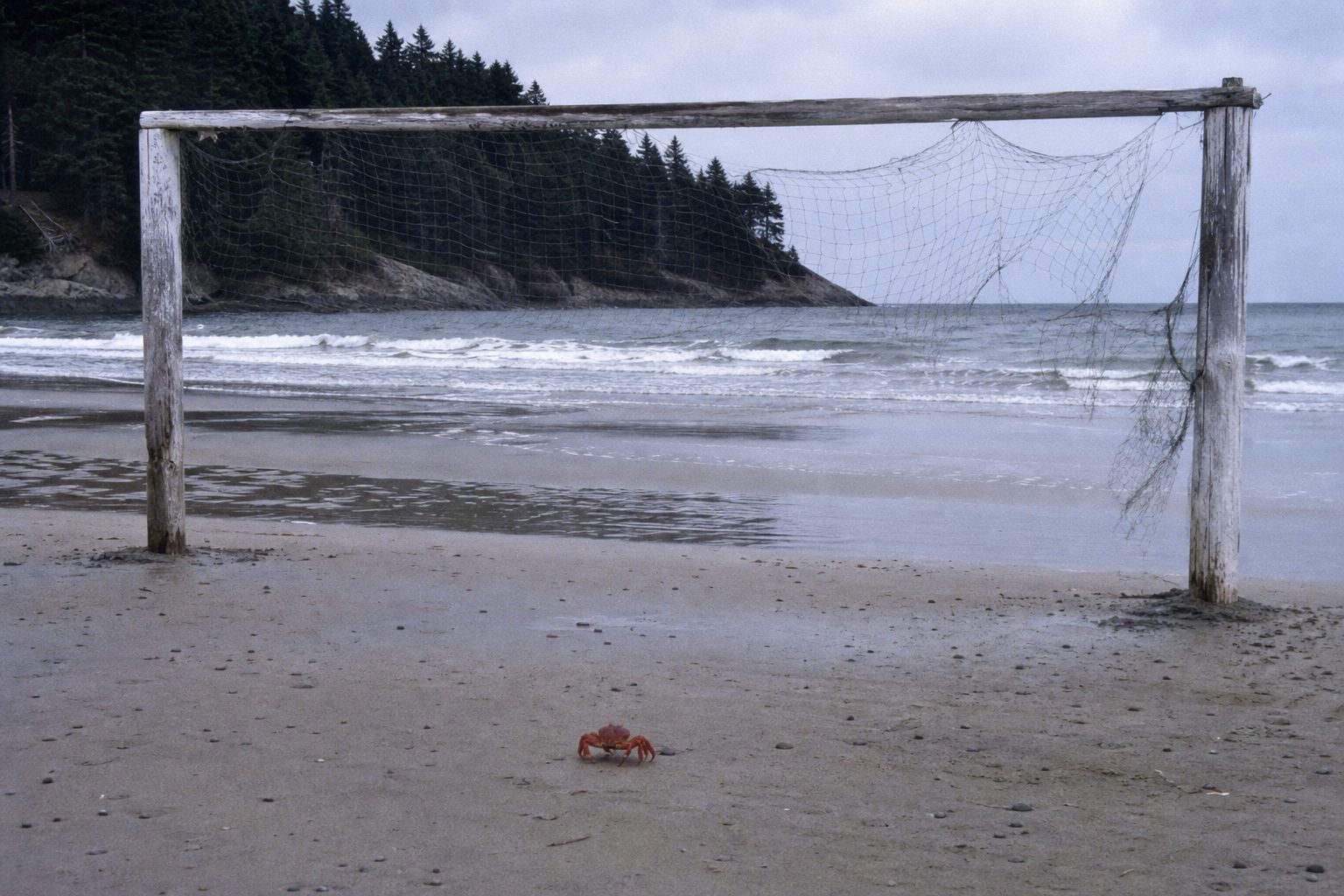
Some film titles need a plot summary. Crab Goalkeeper does not. Released in Japan in 2006 as カニゴールキーパー (Kani Goalkeeper, with the English word simply written in katakana), it is a genuine film with a cast, a crew, a database entry and an official trailer, and that trailer is the sort of thing everyone should be made to watch at least once.
What follows is less a review than an attempt to place it somewhere in the long, strange history of football on screen.
A title that does the work
The appeal of the trailer is how seriously it takes itself. Football films usually come in two flavours: the earnest underdog story, where a team of misfits learns to believe, and the comedy, where everyone knows it is daft. Crab Goalkeeper, judging by its trailer, sits somewhere odd between them, and the title alone is enough to make a football audience stop scrolling.
It also lands on a real truth about the position. Goalkeepers are taught to move sideways. Youth coaches everywhere drill the shuffle across the six-yard box, feet never crossing, body square to the ball, and anyone who has watched a keeper set himself for a penalty has seen something faintly crustacean about it. Nobody, until 2006, seems to have taken the comparison to its logical end.
Japan and football fiction
Japan has a better claim than most countries to taking football fiction seriously. The great landmark is Captain Tsubasa, the manga by Yoichi Takahashi that began in 1981, was turned into an anime and went on to be translated across Europe, the Middle East and South America. A generation of professionals has talked about growing up with it, long before Japan had a professional league of its own.
That league, the J.League, kicked off in 1993. The fiction followed the boom. Shoot!, the 1990s series known in Japan as Aoki Densetsu Shoot!, is featured among the Japanese football anime clips elsewhere in the videos section, and in 2008 the video game and cartoon Inazuma Eleven put a junior-high goalkeeper at the heart of its story, complete with special saves that summon giant glowing hands.
So a film about a crab in goal is not quite as random as it first looks. In Japanese popular culture the goalkeeper has long been a hero figure, and heroes there tend to come with strange powers.

Where Japanese football stood in 2006
The film arrived in a busy year. Japan had co-hosted the 2002 World Cup with South Korea and reached the last 16, losing 1–0 to Turkey in the rain at Miyagi. By 2006 the national team was coached by Zico, the Brazilian great who had also helped build Kashima Antlers in the early years of the J.League.
The World Cup in Germany that summer went badly. Japan led Australia 1–0 in Kaiserslautern until the last minutes, then conceded three times and lost 3–1. A goalless draw with Croatia followed, and a 4–1 defeat to Brazil in Dortmund ended the campaign at the group stage. A side that needed a reliable goalkeeper in the closing stages against Australia might have taken help from anywhere, crabs included.
Japanese clubs had already been part of football’s odder corners for years. For two decades Tokyo hosted the Intercontinental Cup between the champions of Europe and South America, which is how the Aston Villa side of 1982 ended up playing Peñarol in Tokyo for the title of world club champions.
Goalkeepers in the cinema
Cinema has rarely known what to do with goalkeepers. The most famous screen keeper is Sylvester Stallone as Robert Hatch in Escape to Victory (1981), a prisoner-of-war drama in which he shared a dressing room with Pelé, Bobby Moore and Osvaldo Ardiles and was still allowed to save the decisive penalty. Wim Wenders made The Goalkeeper’s Fear of the Penalty in 1972, from Peter Handke’s novel, and it is about as far from Stallone as it is possible to get.
Then there is Shaolin Soccer, Stephen Chow’s 2001 Hong Kong comedy, in which kung fu and football merge into something closer to a cartoon than a match. If Crab Goalkeeper has a close relative, it is probably that.
Against that company, a crab is not even the least plausible keeper ever filmed. A crab, at least, already knows how to move sideways.