 ThreeMatchBan
- 1948Twin crests of Brighton and Hove adopted.
- 1972No crest worn until 1977; a dolphin crest designed in 1974 is never worn.
- 1977Seagull roundel introduced, the official badge until 1998; The Seagulls added in 1980.
- 1998A revised badge in a shield shape, meant to mark a fresh start.
- 2000Centenary season 2000/01: the twin town crests are revived.
- 2011New roundel by KSS, architects of the Amex, replaces the shield from 2011/12; gull redrawn facing the other way with a yellow beak.
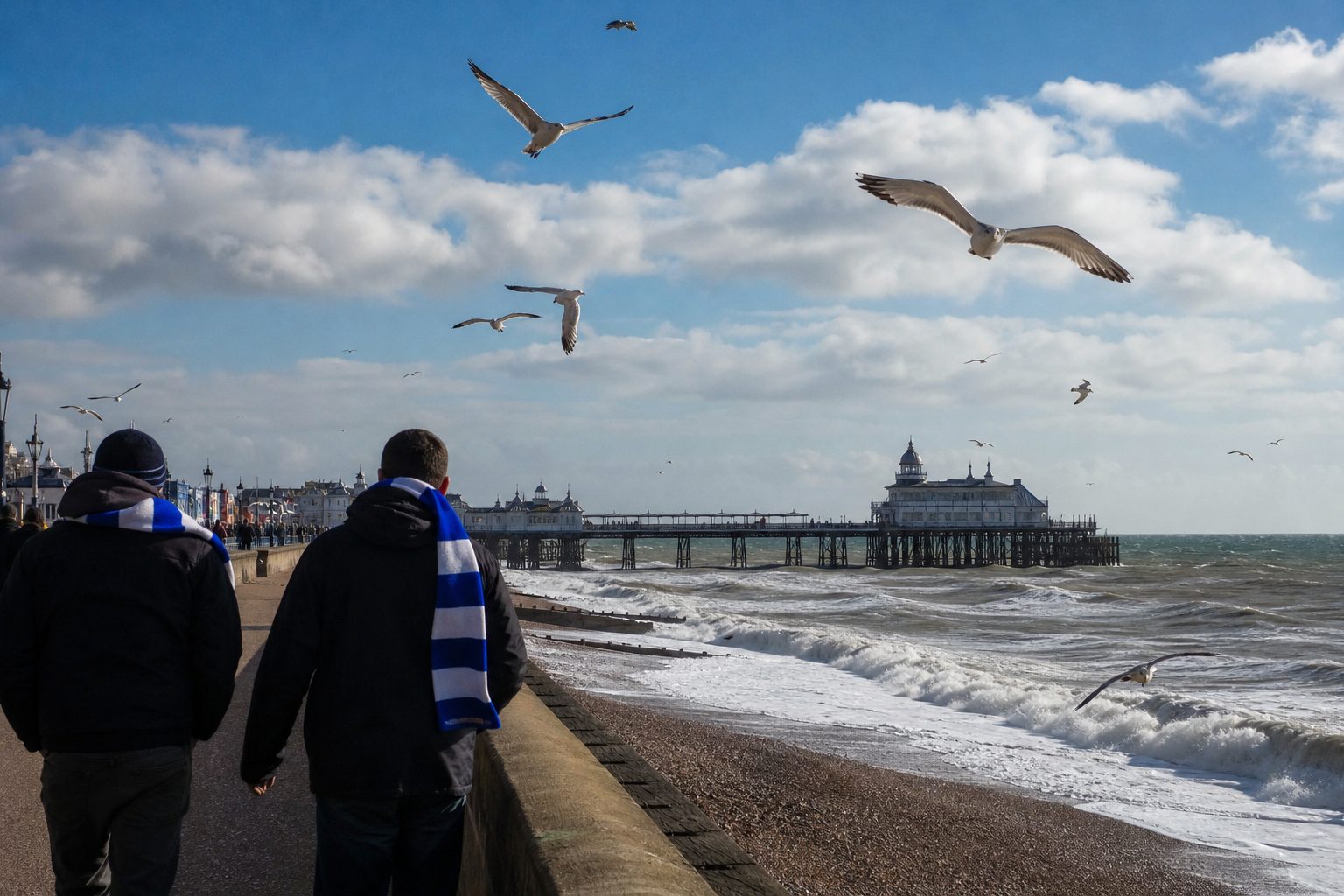
The Brighton badge has gone round in circles, quite literally. The club began with the arms of two towns, spent five years with no crest, put a seagull in a roundel, switched to a shield, went back to the town arms for a centenary and then returned to a roundel. The gull on today's Brighton crest even turned round to face the other way when the club moved to the Amex.
Two towns, two crests: 1948
Brighton & Hove Albion carry two towns in their name, and when the club adopted a badge in 1948 it reflected both. The twin crests of Brighton and of Hove sat side by side, a tidy piece of diplomacy between neighbours who would not become a single city until 2000. Putting both on the shirt neatly avoided having to choose between them.
Heraldry like that was common at the time, and it gave the club a formal, slightly municipal look. It would not last as the main badge, but it was never forgotten either.
The dolphin that never played
From 1972 to 1977 Brighton wore no crest at all. During that gap, in 1974, a dolphin crest was designed but never appeared on the shirts.
It is one of football's more pleasing what-ifs. A dolphin would have suited a seaside club well. Instead the club found its emblem on the terraces.
The seagull roundel and the old Brighton badges
The Seagulls nickname took hold in the 1970s, and by 1977 it was official. That year the club introduced a seagull roundel, a bird inside a circle, which remained the official badge until 1998. In 1980 the words "The Seagulls" were added.
That roundel is the old Brighton badge many fans hold dearest. It was worn in the club's only spell in the old First Division, from 1979 to 1983, and in the 1983 FA Cup final against Manchester United, which went to a replay after a 2–2 draw at Wembley.
In 1998 the roundel gave way to a revised badge in a shield shape, introduced, in the club's words, "to mark a fresh start". It was a fair description. The Goldstone Ground had been sold, the club was sharing Gillingham's ground in Kent, a long way from the seafront, with a move to the athletics stadium at Withdean still to come. A new shape for a new chapter made sense.
For the centenary season of 2000/01 the twin town crests came back, a one-season tribute to the 1948 design and to the two towns that made the club.
2011: the Brighton crest for the Amex
In February 2011 the club unveiled a new identity ahead of its move to the new stadium at Falmer for 2011/12. The design came from KSS, the architects of the Amex itself, and it replaced the shield with a roundel once more.
The timing mattered. The Goldstone had closed in 1997, and the club had spent fourteen years without a permanent home of its own, first at Gillingham and then on the temporary stands at Withdean. A crest drawn by the people who designed the new stadium tied the badge to the building supporters had campaigned for through all those seasons.
The gull was redrawn and now faced the opposite direction, with a yellow beak. Blue and white remained the colours, and the circle echoed the 1977 badge that older supporters still loved, so the new Brighton badge felt familiar from the first day.
The club has since enjoyed the most successful period in its history, reaching the Premier League in 2017 and later playing in Europe, and the 2011 roundel has been on the shirt throughout.
Brighton among their rivals
The fiercest rivalry for Brighton supporters is with Crystal Palace, whose eagle and glass palace are covered on the Crystal Palace badge page. Along the south coast, the Southampton badge and the Bournemouth badge tell their own seaside stories.
Brighton were in the Championship in 2011 and so missed the original Premier League badge survey, but the evolution of Premier League club badges from Arsenal to Manchester United shows how many other clubs have redrawn their crests. Every club history is collected under football badges.
A gull that looks left or right would trouble nobody else. In Brighton, people noticed.