 ThreeMatchBan
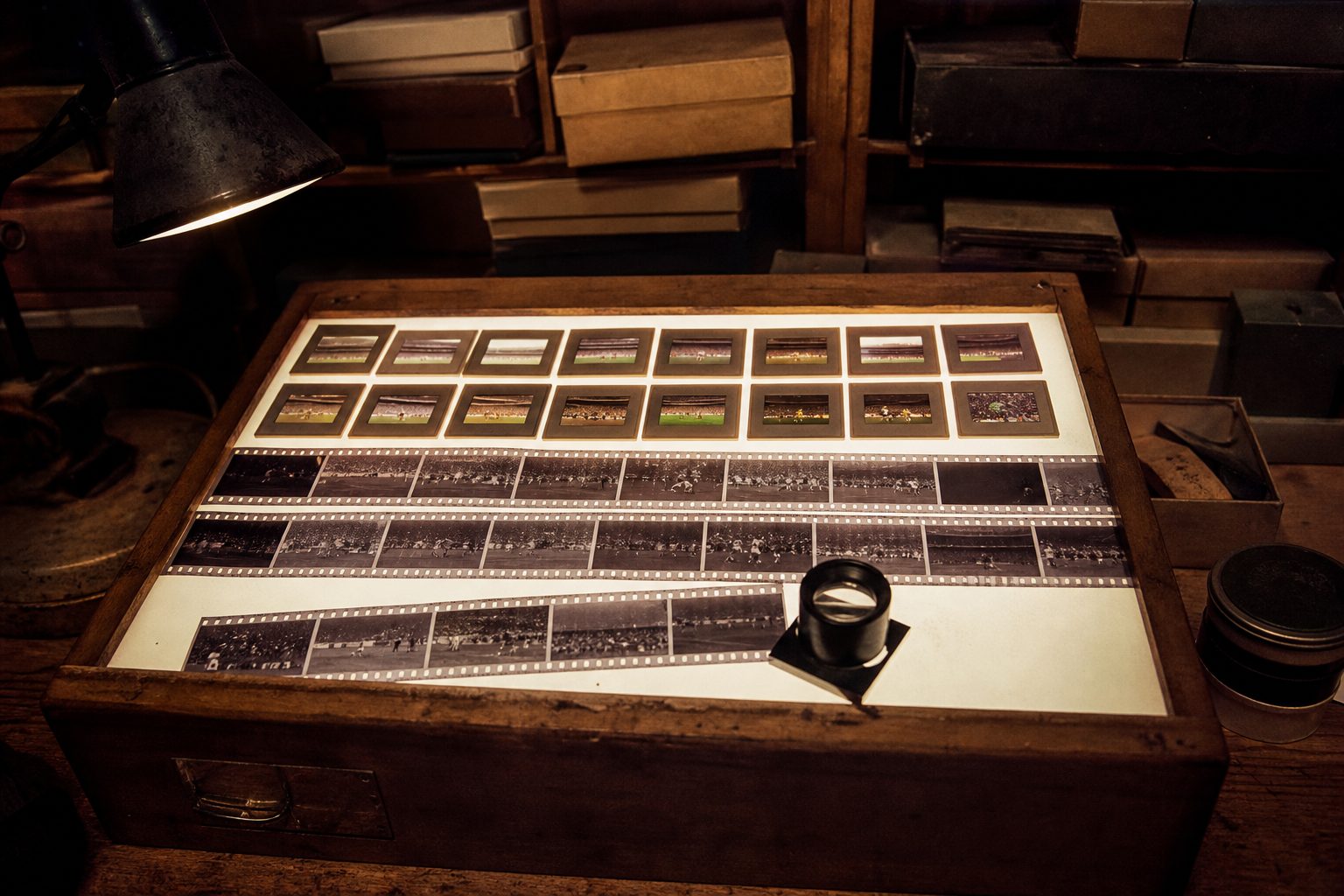
"Football, bloody hell." Sir Alex Ferguson's three words after the 1999 Champions League final in Barcelona, when Teddy Sheringham and Ole Gunnar Solskjær scored in stoppage time to beat Bayern Munich 2–1, remain the most honest summary of the game ever given to a microphone. Some moments in football defy any longer explanation.
Photographs do something similar. A single frame can hold a whole tournament, a whole era of shirt design or the moment a teenager becomes a star. What follows is a short gallery of those frames, with the stories that sit behind them.
Turin, 4 July 1990: the tears of Gazza
There are few more famous pictures in English football. In the World Cup semi-final against West Germany at the Stadio delle Alpi, Paul Gascoigne was booked for a lunging challenge on Thomas Berthold. It was his second yellow card of the tournament, which meant he would miss the final if England got there. His face crumpled, and Gary Lineker famously signalled to the bench to keep an eye on him.
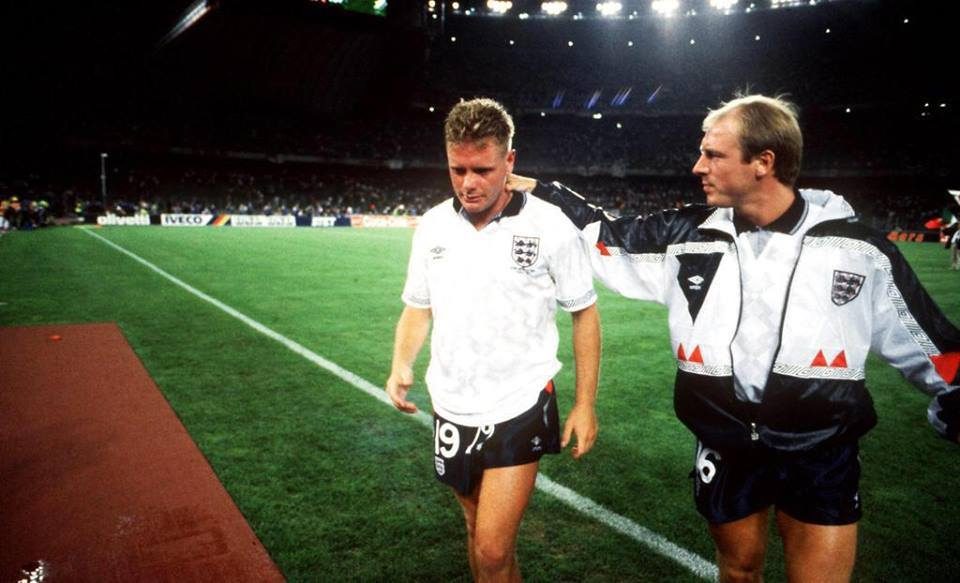
England did not get there. The game finished 1–1 after extra time, and West Germany won the shoot-out after Stuart Pearce and Chris Waddle missed. The career of the second of those, a man far more accomplished than one penalty suggests, is covered in the Chris Waddle profile. In the photograph, Steve McMahon puts an arm round Gascoigne while wearing a tracksuit top that deserves its own place in the history of football fashion: white, navy and a scattering of red triangles.
Those tears changed the way the country saw the game. Within a couple of years football had been reinvented as a national obsession, and Gazza was its first modern celebrity.
Sampdoria, summer 1993: two new arrivals
Serie A in the early 1990s was the richest and most glamorous league in the world, and Sampdoria were among its most fashionable clubs. They had won the Italian title in 1991 and reached the European Cup final at Wembley a year later. In the summer of 1993 they added two big names: David Platt from Juventus and Ruud Gullit from Milan.
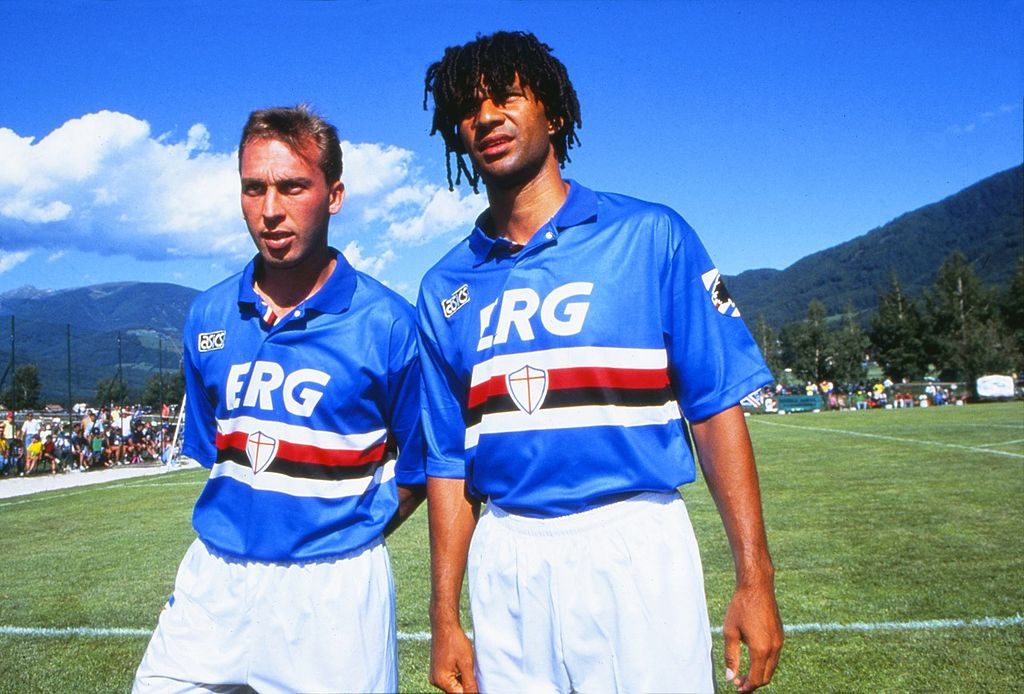
The pair look a little unsure of themselves in the picture, posing in the blue shirts with the white, red and black band across the chest. They need not have worried. Sampdoria finished third in 1993–94 and won the Coppa Italia, and Gullit played some of his best football of the decade in Genoa before returning, briefly, to Milan. That blue shirt still regularly appears in lists of the finest kits ever worn, and the great clubs of the era are the theme of the European giants shirt quiz.
Baggio at Vicenza, Van Basten at Pisa
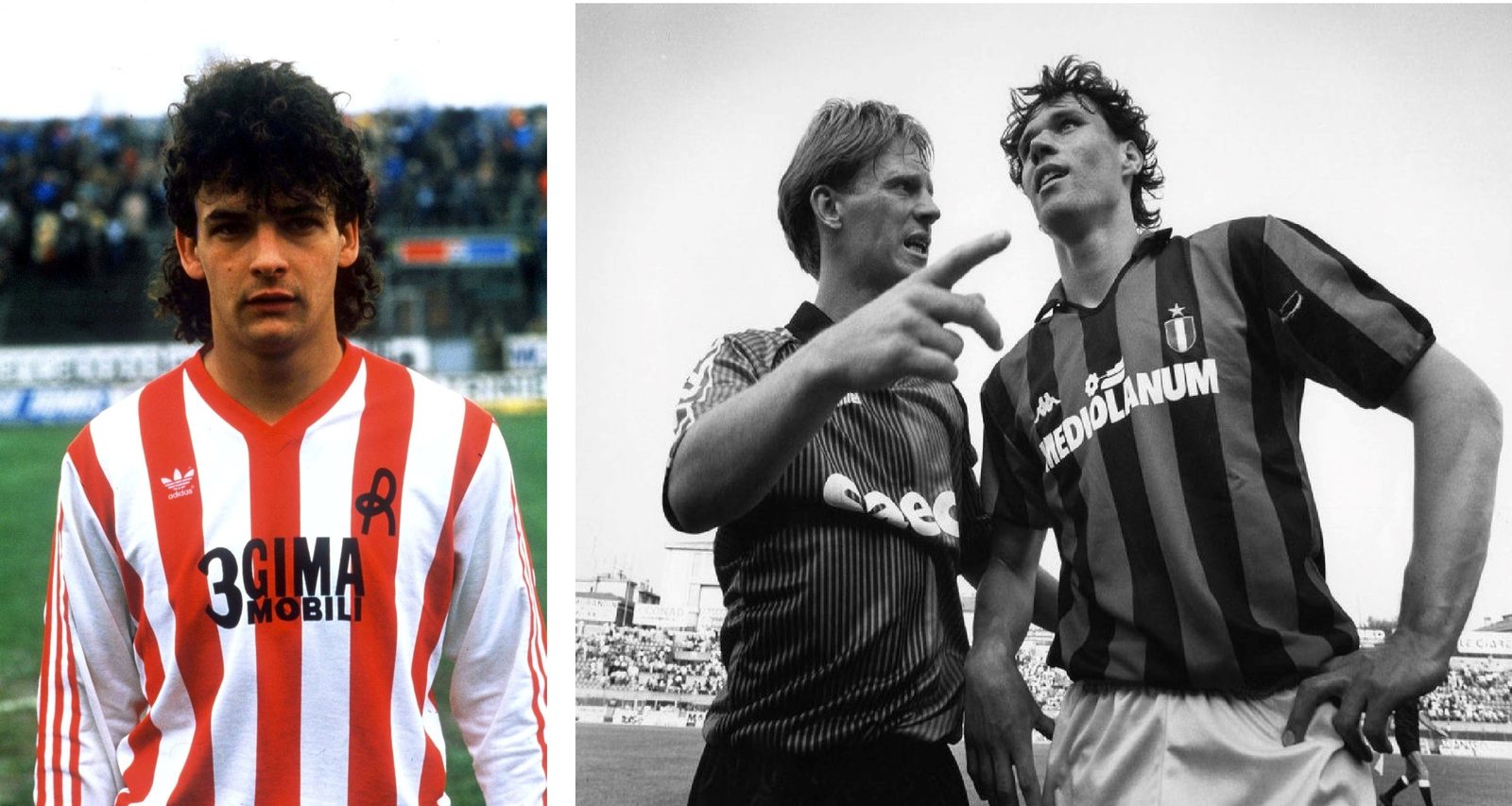
The first half of this picture shows Roberto Baggio as a teenager, a mass of dark curls above the red and white stripes of Vicenza in the 1984–85 season. Vicenza were in Serie C1 at the time, and the young forward's goals helped them to promotion. Fiorentina signed him in 1985, and he went on to become one of the most loved Italian footballers of all time, winning the Ballon d'Or in 1993.
The second half is all about argument. Pisa's Dutch midfielder Mario Been makes his case, finger raised, to Marco van Basten after Milan won 2–0 at the Arena Garibaldi on 11 June 1989. Van Basten, hand on hip, looks entirely unconvinced. Less than three weeks earlier he had scored twice in the 4–0 European Cup final win over Steaua Bucharest, so the lecture probably did not trouble him much.
Sócrates in Barcelona, 1982
Brazil's 1982 side is often called the greatest team never to win the World Cup, and Sócrates was its thinking heart. A qualified doctor, bearded, tall and elegant, he captained a team that played with a freedom rarely seen before or since. In this photograph he holds off an Italian challenge in the heat of the second-round group game at the Estadi de Sarrià, the old home of Espanyol.
The match on 5 July 1982 is one of the most famous in World Cup history. Sócrates scored Brazil's first equaliser, but Paolo Rossi completed a hat-trick and Italy won 3–2. Brazil needed only a draw. Italy went on to win the tournament, and the picture of Sócrates is credited to Flickr / oyosan, a reminder of how many treasured football images now survive through enthusiasts' collections.
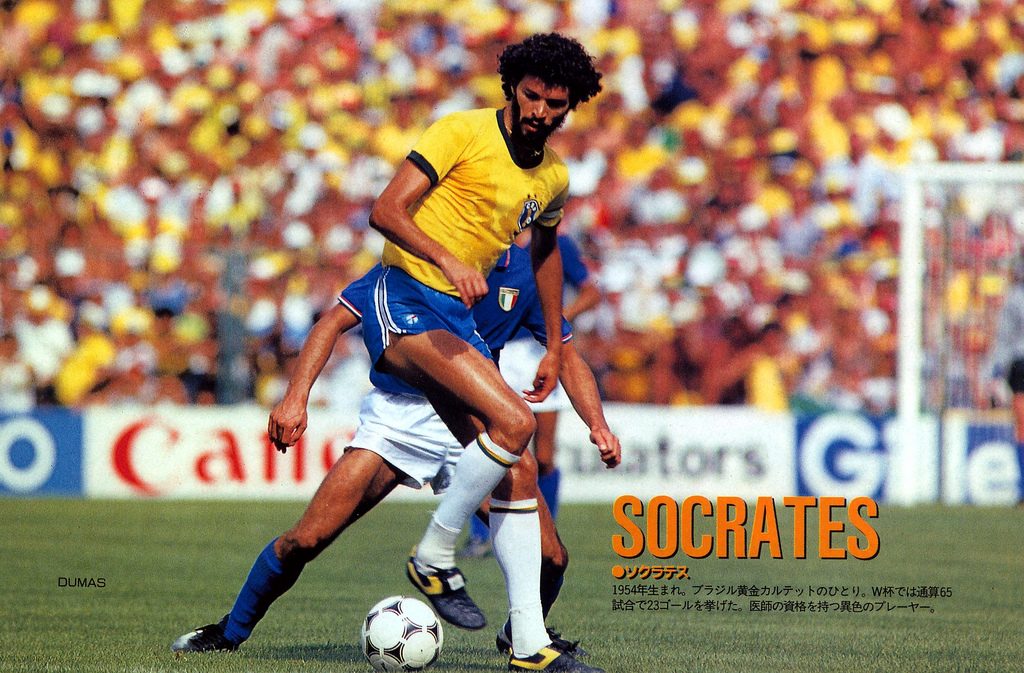
Sarrià itself is gone, demolished in 1997, which makes every picture of that afternoon a little more precious.
Three young Italians before they were famous
The last frame offers three portraits of the young men who would shape Italian football for two decades. On the left, Antonio Conte at Lecce, his home-town club, with a fine head of hair and a yellow and red shirt. He joined Juventus in 1991, won everything there as a player and later became one of the most successful managers in Europe, including a Premier League title with Chelsea in 2017.
In the middle, Gianluca Vialli at Cremonese in 1983–84, a riot of curls above red and grey stripes and a shirt sponsor that advertised a famous Italian cheese. He later formed a famous partnership with Roberto Mancini at Sampdoria, then captained Juventus to the Champions League in 1996 and ended up player-manager at Chelsea.
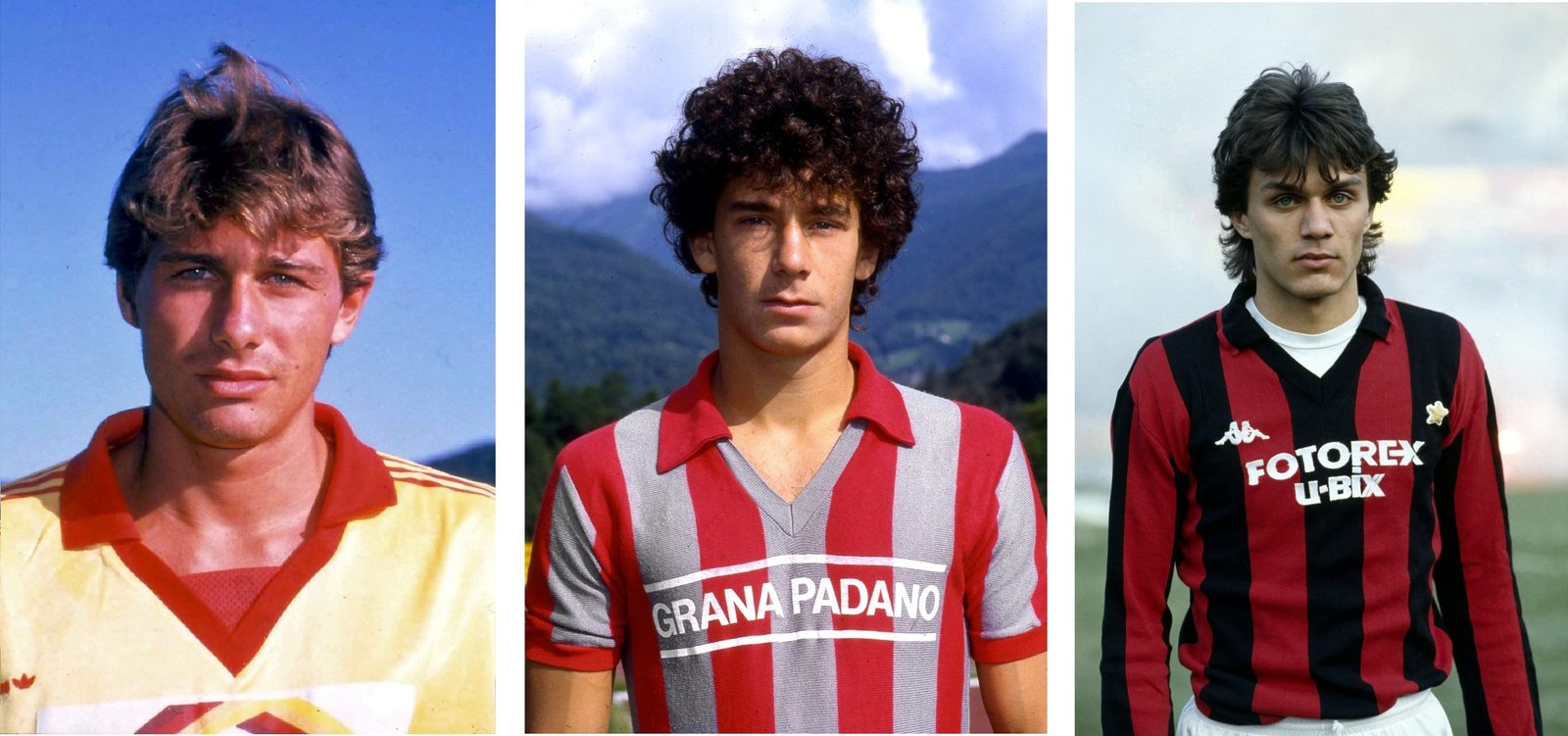
On the right, a 17-year-old Paolo Maldini at Milan in 1985, solemn and already wearing the red and black that he would never take off. He made his debut for the club as a 16-year-old in January 1985 and stayed for 25 years. The way these faces reached British living rooms, through grainy satellite highlights and late-night Italian football on terrestrial television, is recalled in a look back at the video age of football.