 ThreeMatchBan
Before the internet, a football-obsessed child with a hunger for facts had few places to go. There was no Wikipedia for a quick biography, no search engine to show what a name on the vidiprinter actually looked like. The answer for a whole generation was smaller and far more addictive: football stickers, and their bulkier cousins, football cards.
Old albums still reward a trawl. Flick through one and half-forgotten names resurface, along with details buried in the memory for decades. Four collections stand above the rest, each for very different reasons.
Orbis: an encyclopaedia with stickers attached
The Orbis Football Collection of 1990–91 was the original and, for many, the definitive set. Sold in weekly instalments, it went far beyond pages of empty boxes and a list of club honours. The stickers came first, but they were arranged oddly, by playing position rather than by club, and the whole thing lived in a ring-binder, a format usually reserved for card collections.
Those quirks only made it more fascinating. Sorting by position meant a snippet of information on every player alongside well-chosen action shots. Then the extras kept coming: a club directory covering every team in England and the Scottish top division, biographies of stars past and present, features on great goals and memorable matches, and historical flashbacks.
The record transfer fees printed in that club directory now look microscopic, a neat reminder of how far the game’s finances have travelled since 1990. For a statistically minded youngster, often with a grandparent filling in the gaps, it was less a playground pastime and more a reference book.
Pro-Set: the card set that covered all four divisions
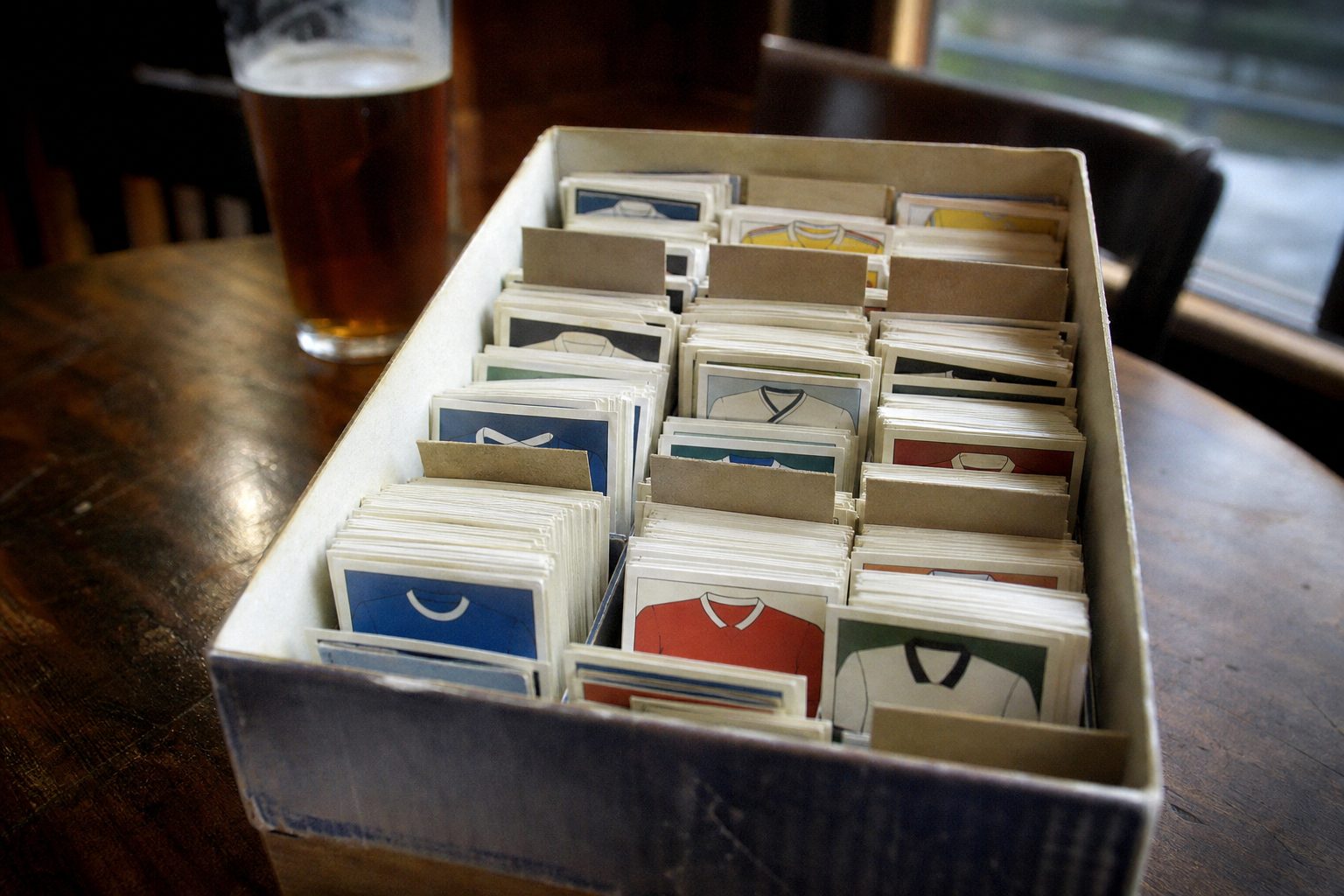
Cards had one big drawback. They were bulky, needed enormous folders and did not fit into school trousers. Stickers were therefore the natural choice, with one notable exception: the Pro-Set series for 1990–91.
Pro-Set ignored the habit, soon to dominate collecting, of caring only about the top flight. It covered all four divisions, signalled by the coloured strip carrying each player’s name down the left of the card: red, blue, yellow and a murky green as the leagues descended. The lower the division, the fewer cards, focusing on key players from a handful of clubs. Among them were cult hero Luther Blissett during a brief spell at Bournemouth and a young Dion Dublin at Cambridge United, years before his Premier League goals.
Without space for a full biography, Pro-Set printed a short pen portrait on the back of each card. The writing was crisp and often witty, conjuring more about a player than any column of statistics; its description of Paul McGrath was a particular favourite and lifted the series well above its imitators.
Panini Italia 90: the world in one album
Panini, founded by the Panini brothers in Modena in the early 1960s, set the template that every later album copied, and its Italia 90 World Cup book was a high point. For a child whose horizons stopped at the Barclays First Division, it opened a door to a wider game: before a ball was kicked, collectors knew who played for which country, where they played their club football and how each nation had qualified.
The album was beautifully sparse, with essential details and players lined up for the anthems. A cost-saving trick gave it extra charm. Rather than print a separate edition for each country, Panini wrote each team’s name in its own language with translations alongside, which is how a generation of British children came to believe Belgium was called Belgique-België. The album also introduced the magnificent hair-and-moustache combination of Uruguay’s Eduardo Pereira, and the South American pages in general were a festival of facial hair.
West Germany won the tournament, beating Argentina 1–0 in Rome, and England went out in the semi-finals on penalties. The stickers outlasted the tears.
Merlin 1994: shiny kits and the start of the money
By the time Merlin released its Premier League collection in 1994, football was no longer a hobby for the few. Everyone in the playground wanted to know what Roy Wegerle looked like or needed the Norwich City team photo to finish the set.
The fuss was justified. Merlin had uniform portraits of every squad and plenty of extras: miniature replicas of each club’s matchday programme, a window onto other grounds for children yet to go on an away day, and shiny foil versions of every kit, still the most treasured stickers of the lot.
A centre-page feature promoting Sky Sports went over most young heads, but in hindsight it marked the commercial turn the game was taking. It included John Salako in remarkably brief shorts and presenter Richard Keys in a bright yellow jacket, odd choices for a feature trying to sell a slick professional brand.
However glossy it was, Merlin kept the basics of information, and that is what sent collectors back to the album whenever an unfamiliar name cropped up on Match of the Day. Panini later took the Premier League licence back, and the swaps continue. Anyone who still knows those faces can test themselves on the world football sticker quiz, the Premier League imports quiz or, for the moustache enthusiasts, the facially fuzzy players quiz.